
The Song of Eternal Knowledge: When the Gita Redeemed Two Heavenly Souls
The Transformative Power of the Fourth Chapter — Jnana Yoga, the Yoga of Wisdom
The Devout Brahmin of Kashi
In the luminous city of Kashi, where the sacred Ganga mirrors the heavens, there lived a devout Brahmin named Devadatta. His life was one of quiet austerity and divine rhythm — the steady cadence of morning ablutions, sacred rituals, and the daily recitation of the Bhagavad Gita. Among its chapters, the fourth, known as Jnana Yoga — the Yoga of Wisdom — was dearest to him. For in it, he found not just doctrine, but direct communion with the eternal.
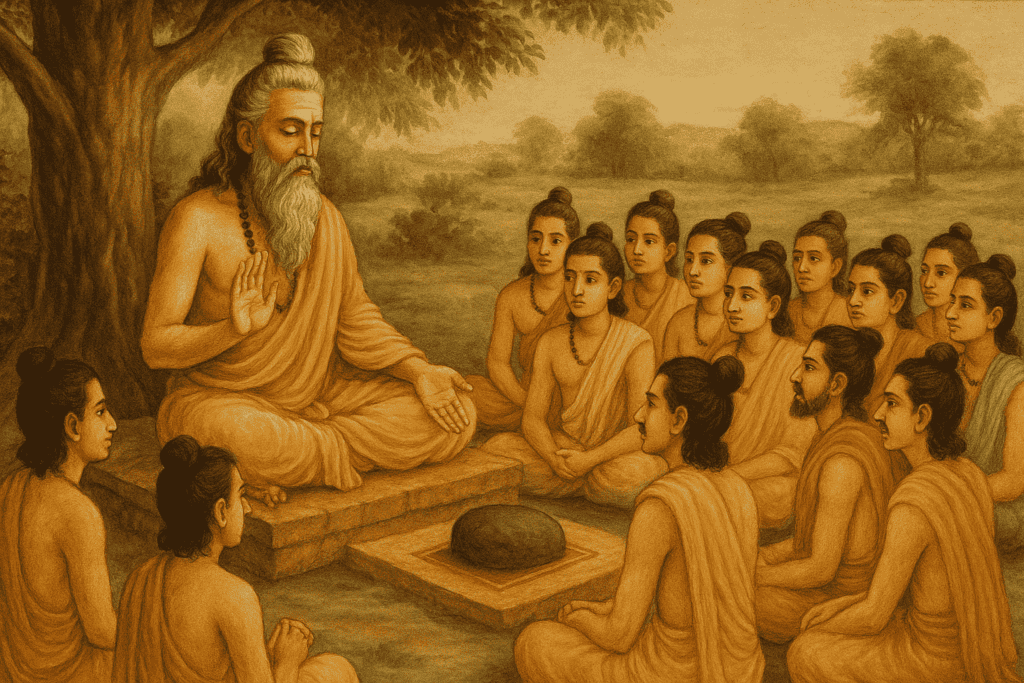
One morning, filled with an inner calling, Devadatta resolved to seek the blessings of the great sage Vedavyasa, the divine compiler of the Vedas and author of the Mahabharata. Carrying only his faith and his voice, he set forth across the sacred Ganga, the river of wisdom itself.
After walking a long distance under the tender dawn, Devadatta arrived at a small well surrounded by two berry trees. He bathed, performed his prayers, and sat beneath their shade to recite the fourth chapter of the Gita. Each syllable resonated through the still air — the sacred vibrations touching not just the visible world, but the unseen realms that surround it.
When he had finished his reading, he offered silent salutations to the Divine and continued on his journey, unaware that his simple act of devotion had just altered the destiny of two imprisoned souls.
The Redemption of the Berry Trees
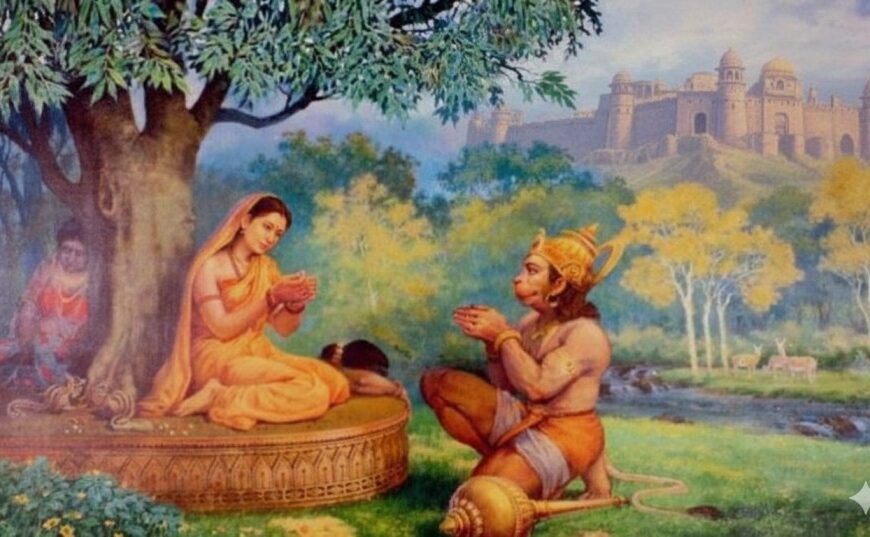
Some days later, as Devadatta sat by the banks of the Ganga in contemplation, two radiant young women approached him. Draped in modest beauty and glowing with gratitude, they bowed low before him.
“Revered one,” they said, “we are here to express our eternal gratitude. By your grace, we have been freed from the bondage that held us for ages.”
Devadatta, taken aback, asked gently, “By my grace? I do not understand. Who are you, and what bondage do you speak of?”
The two maidens smiled and began to reveal their astonishing story.
“We were once celestial dancers in the court of Lord Indra. By divine order, we descended to the earth to disturb the meditation of the great sage Satyatapa, who was absorbed in deep penance on the banks of the Godavari. Enchanted by our music and movements, we sought to distract his mind. But the sage, seeing through our vanity, opened his eyes of fire and cursed us to become two Badari (berry) trees, rooted to the very ground where we had dared disturb his meditation.
In terror and remorse, we fell at his feet, begging forgiveness. The sage’s heart softened, and he declared: ‘When a Brahmin, pure in heart and devotion, recites the fourth chapter of the Bhagavad Gita beneath your shade, you will regain your celestial form and ascend again to your rightful home.’
Ages passed. We stood there — two silent trees, enduring rain, sun, and seasons, waiting for that sacred sound to touch our bark and awaken our souls. And then, O holy one, you came. When your voice uttered the verses of Jnana Yoga, the fire of knowledge dispelled our curse. The bondage of form dissolved, and we were reborn — free, conscious, and grateful beyond words.”
The Song of Jnana Yoga – The Yoga of Wisdom
The two maidens, transformed from trees into celestial beings once more, began to live by the very wisdom that had freed them. They recited the fourth chapter every day, and through that practice, they ascended again to the heavenly realms — this time not as dancers bound to duty, but as liberated souls immersed in divine bliss.
What, then, is this Yoga of Wisdom that holds such power — capable of redeeming not only men, but even trees, spirits, and celestial beings?
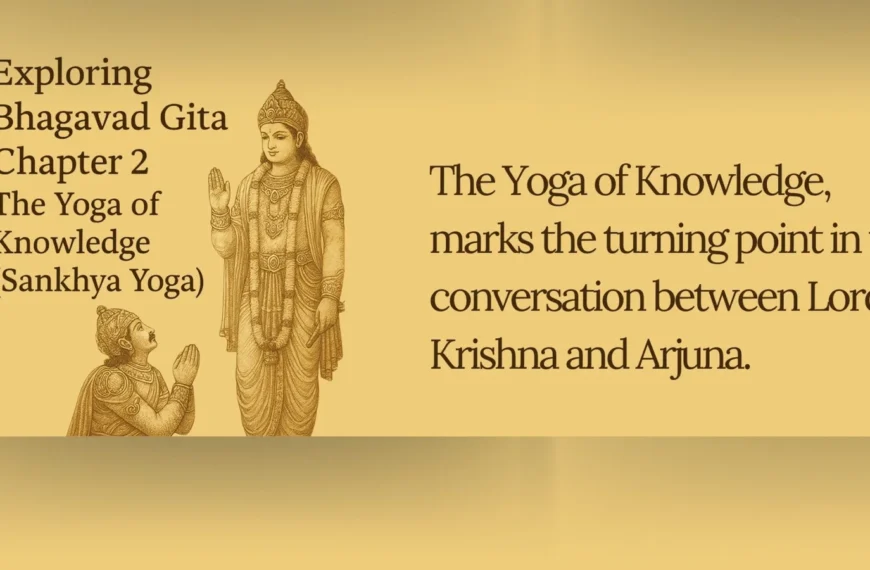
In this sacred chapter, Lord Krishna unveils the timeless knowledge of action, divinity, and liberation. He tells Arjuna that this Yoga was not newly spoken; it was the eternal science of the soul, passed down through generations of royal sages — from the dawn of creation itself. Yet, over time, it had been lost in the noise of human forgetfulness.
He says:
“Whenever righteousness declines and unrighteousness rises, I manifest Myself —
for the protection of the good, for the destruction of evil, and for the re-establishment of Dharma.”
These words are not history but cosmic principle. They remind us that the Divine does not belong to any one era or faith — God is a living presence that manifests whenever the balance of truth must be restored.
The Fire of Knowledge That Burns All Karma
Krishna reveals to Arjuna that wisdom alone can purify the soul. He who performs all actions in the light of this knowledge is never bound by them.
“He who sees inaction in action and action in inaction is wise among men.
His every act is a sacrifice, for he acts without desire.”
True knowledge, Krishna teaches, is not intellectual — it is transformative. It burns the seeds of karma, just as a blazing fire consumes all fuel. A person established in wisdom becomes like that fire — radiant, unattached, yet full of warmth and purpose.
To such a person, every action becomes worship.
The act of eating, the offering, the fire, the clarified butter, the performer — all are seen as Brahman. In this realization, there is no duality, no “I” and “you.” The entire world becomes an expression of the same infinite consciousness.
The Many Sacrifices, The One Truth
In one of the most profound sections of this chapter, Krishna describes the various forms of Yajna (sacrifice) — symbolic of the diverse spiritual paths humans take:
- Some offer material wealth in service.
- Some sacrifice their senses through discipline and restraint.
- Some dedicate their intellect in the pursuit of knowledge.
- Others, through meditation, offer the very breath in the fire of self-awareness.
But the Lord declares:
“Of all sacrifices, the sacrifice of knowledge is supreme.
For through knowledge, all actions culminate in realization.”
Here lies the heart of Jnana Yoga:
That true spirituality is not about external offerings, but the inner offering of ignorance into the fire of wisdom.
When a seeker surrenders their ego, questions earnestly, and serves the wise, the light of truth dawns — not as belief, but as direct experience.
The Sword of Knowledge
Krishna concludes the chapter with a call that reverberates through eternity:
“Even if you are the greatest of sinners, you shall cross the ocean of suffering by the raft of knowledge.
As fire reduces wood to ashes, so does wisdom burn all karma to ashes.
Therefore, arise, O Arjuna! Cut through all doubt born of ignorance with the sword of knowledge.
Be firm in Yoga, and act.”
This is not merely advice to a warrior on the battlefield — it is the eternal summons to every human being trapped in confusion. The sword of knowledge is not violence — it is clarity, the cutting away of illusion and false identity.
The “battle” Krishna speaks of is not outer war but the inner conflict — the struggle between the lower self, driven by desire and fear, and the higher Self, radiant with truth and stillness.
The Universal Message
The story of Devadatta and the two celestial maidens is more than a myth. It is a metaphor for how divine wisdom awakens even the inert, how sacred knowledge can redeem all forms of life.
It tells us that Jnana Yoga is not an escape from life, but a transformation of perception — seeing the Divine in everything. Just as the two berry trees found liberation through the vibration of sacred words, we too can awaken through the sound of truth, the practice of inquiry, and the fire of awareness.
In every age, in every heart, the Lord still whispers:
“I am born again and again, wherever Dharma declines —
not merely in the world outside, but within you,
to restore balance, truth, and love.”
Conclusion: The Eternal Dawn of Wisdom
Devadatta’s devotion reminds us that even the smallest act of sincerity — a verse recited, a prayer whispered, a heart opened — can ripple across worlds and transform destinies unseen.
The fourth chapter of the Gita does not merely teach — it awakens. It reveals that wisdom is not acquired; it is remembered — the rediscovery of what the soul has always known.
When knowledge burns ignorance, when devotion purifies action, and when awareness dissolves duality, one attains what Krishna calls the supreme peace — the bliss of Brahman.
The trees, the priest, the maidens, the seeker, and the sage — all are fragments of one great song, the Song of Eternal Knowledge — the Gita itself.

 By
By