
The Surya Upanishad, nestled within the Hindu Atharva Veda, is one of the most luminous expressions of Vedic spirituality. It is a hymn to Surya, the Sun—not merely as a celestial body, but as the cosmic intelligence, the life-giver, the witness of all, and the inner light present in every being.
Across cultures and continents, the sun has always symbolized warmth, hope, clarity, and rebirth. In this Upanishad, these universal themes blend seamlessly with profound metaphysical insights and devotional reverence. Lets begin:
A Hymn to the Sun as the Ultimate Reality
The below provided original Sanskrit texts is the Suryopanishad,that extols Surya, the Sun God, not merely as a celestial body but as the ultimate reality, Brahman. It presents a profound monistic philosophy where the sun is identified with the creator, preserver, and destroyer of the universe, and indeed, with the very consciousness that pervades all existence.
Here is a detailed translation and explanation of the text:
The Peace Invocation (Shanti Mantra)
अथर्ववेदीय सामान्योपनिषत् ।
सूदितस्वातिरिक्तारिसूरिनन्दात्मभावितम् ।सूर्यनारायणाकारं नौमि चित्सूर्यवैभवम् ॥
ॐ भद्रं कर्णेभिः श्रुणुयाम देवाः । भद्रं पश्येमाक्षभिर्यजत्राः ।स्थिरैरङ्गैस्तुष्टुवांसस्तनूभिर्व्यशेम देवहितं यदायुः ।स्वस्ति न इन्द्रो वृद्धश्रवाः । स्वस्ति नः पूषा विश्ववेदाः ।स्वस्ति नस्तार्क्ष्यो अरिष्टनेमिः । स्वस्ति नो बृहस्पतिर्दधातु ॥
ॐ शान्तिः शान्तिः शान्तिः ॥
Translation:
Atharvavediya Samanyopanishad.
I bow down to the glory of the Sun of consciousness, whose form is Surya Narayana, who is realized by the wise as the self, who is the destroyer of enemies other than the self.
Om! O Devas, may we hear with our ears what is auspicious. O worthy ones of worship, may we see with our eyes what is auspicious.With steady limbs and bodies, may we offer our prayers and enjoy the lifespan allotted by the gods.May Indra of great fame bless us. May Pushan, the all-knowing, bless us. May Tarkshya (Garuda), who protects from all harm, bless us. May Brihaspati bestow well-being upon us.
Om! Peace! Peace! Peace!
Explanation:
The text begins by identifying itself as a general Upanishad of the Atharva Veda. The opening verse is a salutation to Surya Narayana, a composite form of the Sun God (Surya) and Lord Vishnu (Narayana), emphasizing the sun’s divine and all-encompassing nature. This verse sets the philosophical tone, portraying the sun as the ultimate consciousness.
Following this is a standard Vedic peace invocation, the “Bhadram Karnebhih” mantra.This prayer is a collective appeal for well-being, seeking auspiciousness in all sensory experiences and a long, healthy life dedicated to divine service. It invokes blessings from several prominent Vedic deities: Indra (the king of gods), Pushan (a solar deity associated with nourishment and guidance), Tarkshya (often identified with Garuda, the celestial eagle, symbolizing protection), and Brihaspati (the preceptor of the gods, representing wisdom). The threefold utterance of “Shanti” (peace) is to pacify disturbances from three sources: the divine (Adidaivika), the self (Adhyatmika), and the physical world (Adhibhautika).
The Essence of the Suryopanishad
हरिः ॐ अथ सूर्याथर्वाङ्गिरसं व्याख्यास्यामः ।ब्रह्मा ऋषिः । गायत्री छन्दः । आदित्यो देवता ।हंसः सोऽहमग्निनारायणयुक्तं बीजम् । हृल्लेखा शक्तिः ।वियदादिसर्गसंयुक्तं कीलकम् ।चतुर्विधपुरुषार्थसिद्ध्यर्थे विनियोगः ।
Translation:
Hari Om. Now, we shall explain the Suryatharvangirasa. The sage (Rishi) is Brahma. The meter (Chhanda) is Gayatri. The deity (Devata) is Aditya (the Sun). The seed (Bija) is “Hamsah So’ham” combined with Agni (fire) and Narayana. The power (Shakti) is Hrillekha. The pin (Kilaka) is that which is connected with the creation, beginning with space. The application (Viniyoga) is for the attainment of the four goals of human life.
Explanation:
This section outlines the technical aspects of the Upanishad, treating it as a powerful mantra.
- Rishi (Sage): Brahma, the creator god, is the seer who first perceived this knowledge.
- Chhanda (Meter): Gayatri, a revered Vedic meter of 24 syllables, signifies the rhythmic structure of the verses.
- Devata (Deity): Aditya, another name for the Sun God, is the central focus of this Upanishad.
- Bija (Seed Mantra): “Hamsah So’ham” is a profound mantra identifying the individual self with the universal self, literally meaning “I am He.” Its combination with Agni (fire, representing transformative energy) and Narayana (the cosmic preserver) creates a potent seed sound for meditation.
- Shakti (Power): Hrillekha refers to the divine feminine energy that activates the mantra.
- Kilaka (Pin): This is what locks or unlocks the power of the mantra, here associated with the process of creation.
- Viniyoga (Application): The purpose of this knowledge is to achieve the four purusharthas or goals of human existence: Dharma (righteousness), Artha (wealth), Kama (desire), and Moksha (liberation).
The Dhyana (Meditative Visualization) of Surya Narayana
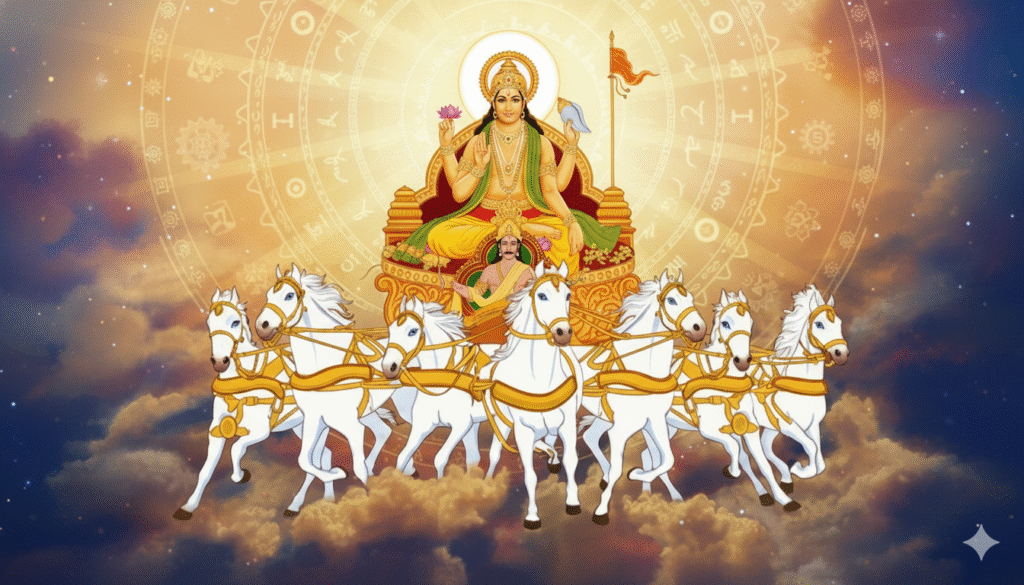
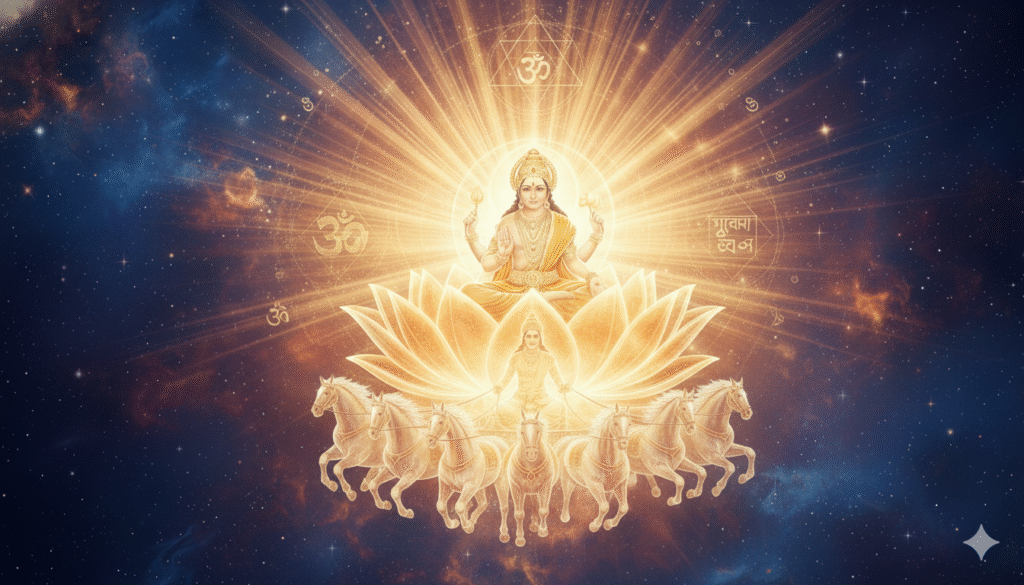
षट्स्वरारूढेन बीजेन षडङ्गं रक्ताम्बुजसंस्थितम् ।सप्ताश्वरथिनं हिरण्यवर्णं चतुर्भुजंपद्मद्वयाभयवरदहस्तं कालचक्रप्रणेतारंश्रीसूर्यनारायणं य एवं वेद स वै ब्राह्मणः ।
Translation:
He who knows the six-limbed form through the seed mantra with six vowels, who is seated on a red lotus, who rides a chariot drawn by seven horses, who is of golden complexion, four-armed, holding two lotuses, and displaying the gestures of fearlessness (abhaya) and boon-bestowal (varada), the impeller of the wheel of time, that Sri Surya Narayana—he is indeed a true Brahmana.
Explanation:
This verse provides a detailed description of Surya Narayana for the purpose of meditation. The symbolism is rich:
- Riding a chariot drawn by seven horses: This is a classic depiction of the Sun God, where the seven horses are said to represent the seven days of the week, the seven colors of the rainbow, or the seven chakras.
- Golden complexion: Signifies radiance, purity, and divine effulgence.
- Four-armed: A common feature of Hindu deities, indicating divine power and the ability to perform multiple actions simultaneously.
- Holding two lotuses: The lotus is a symbol of purity, enlightenment, and creation.
- Abhaya and Varada mudras: These hand gestures signify the divine promise of protection from fear and the granting of boons.
- Impeller of the wheel of time: This highlights Surya’s role in governing the cycles of day and night, seasons, and the very flow of time.
The verse concludes by stating that one who truly understands this form of Surya Narayana attains the status of a Brahmana, which in this context means one who has realized Brahman, the ultimate reality.
The Gayatri Mantra and the Oneness of Surya
ॐ भूर्भुवःसुवः । ॐ तत्सवितुर्वरेण्यं भर्गो देवस्यधीमहि । धियो यो नः प्रचोदयात् ।सूर्य आत्मा जगतस्तस्थुषश्च । सूर्याद्वै खल्विमानिभूतानि जायन्ते ।सूर्याद्यज्ञः पर्जन्योऽन्नमात्मा नमस्त आदित्य ।
Translation:
Om, the physical, the astral, and the celestial worlds. Om, we meditate on the adorable glory of the radiant Savitur (the Sun); may he inspire our intelligence. The Sun is the soul of all that moves and all that is stationary. From the Sun, verily, are all these beings born. From the Sun arise sacrifice, rain, food, and the soul. Salutations to you, O Aditya.
Explanation:
This section begins with the sacred Gayatri Mantra, one of the most revered hymns in Hinduism, addressed to Savitur, an aspect of the Sun God representing the creative and illuminating power of the divine. Its inclusion here directly links the wisdom of the Vedas to the central theme of the Upanishad.
The subsequent verses unequivocally declare Surya as the source of all creation. He is the Atman (soul) of both the animate and the inanimate. All beings, and even the fundamental elements of existence like sacrifice (yajna), rain (parjanya), and food (anna), are said to originate from the Sun. This establishes Surya not just as a physical entity but as the primordial source of all life and sustenance.
Surya as the Manifestation of the Divine Trinity and the Vedas
त्वमेव प्रत्यक्षं कर्मकर्तासि । त्वमेव प्रत्यक्षं ब्रह्मासि ।त्वमेव प्रत्यक्षं विष्णुरसि ।त्वमेव प्रत्यक्षं रुद्रोऽसि । त्वमेव प्रत्यक्षमृगसि ।त्वमेव प्रत्यक्षं यजुरसि ।त्वमेव प्रत्यक्षं सामासि । त्वमेव प्रत्यक्षमथर्वासि ।त्वमेव सर्वं छन्दोऽसि ।
Translation:
You are the visible doer of actions. You are the visible Brahma. You are the visible Vishnu. You are the visible Rudra. You are the visible Rig Veda. You are the visible Yajur Veda. You are the visible Sama Veda. You are the visible Atharva Veda. You are all the meters.
Explanation:
Here, the Upanishad elevates Surya to the status of the supreme deity by identifying him with the Hindu trinity—Brahma (the creator), Vishnu (the preserver), and Rudra (the destroyer). This means that all the fundamental cosmic functions are manifestations of the Sun’s power. Furthermore, Surya is equated with the four Vedas, the foundational scriptures of Hinduism. This signifies that all sacred knowledge and wisdom emanate from the Sun. By also being identified with all the meters (chhandas), Surya is portrayed as the source of all sacred expression.
The Cosmic Manifestations of Surya
आदित्याद्वायुर्जायते । आदित्याद्भूमिर्जायते । आदित्यादापोजायन्ते । आदित्याज्ज्योतिर्जायते ।आदित्याद्व्योम दिशो जायन्ते । आदित्याद्देवा जायन्ते ।आदित्याद्वेदा जायन्ते ।आदित्यो वा एष एतन्मण्डलं तपति । असावादित्यो ब्रह्म ।
Translation:
From Aditya, air is born. From Aditya, the earth is born. From Aditya, water is born. From Aditya, light is born. From Aditya, space and the directions are born. From Aditya, the gods are born. From Aditya, the Vedas are born. Aditya, indeed, is this sphere that shines. That Aditya is Brahman.
Explanation:
This section further elaborates on Surya’s role as the ultimate source of all existence. It lists the fundamental elements of creation—air, earth, water, light, space—and the celestial beings (devas) and sacred texts (Vedas) as originating from the Sun. The verse culminates in the Mahavakya (great saying) of this Upanishad: “Asav adityo brahma” – “That Aditya is Brahman.” This is the central philosophical declaration, equating the Sun with the formless, attributeless, ultimate reality of Brahman.
Surya as the Inner Self and the Functions of the Body and Mind
आदित्योऽन्तःकरणमनोबुद्धिचित्ताहङ्काराः । आदित्यो वैव्यानः समानोदानोऽपानः प्राणः ।आदित्यो वै श्रोत्रत्वक्चक्षूरसनघ्राणाः । आदित्यो वैवाक्पाणिपादपायूपस्थाः ।आदित्यो वै शब्दस्पर्शरूपरसगन्धाः । आदित्यो वैवचनादानागमनविसर्गानन्दाः ।आनन्दमयो ज्ञानमयो विज्ञानानमय आदित्यः ।
Translation:
Aditya is the inner instrument: mind, intellect, consciousness, and ego. Aditya is indeed Vyana, Samana, Udana, Apana, and Prana (the five vital airs). Aditya is indeed the senses of hearing, touch, sight, taste, and smell. Aditya is indeed the organs of speech, hands, feet, excretion, and generation. Aditya is indeed sound, touch, form, taste, and smell. Aditya is indeed the functions of speech, grasping, movement, excretion, and enjoyment. Aditya is full of bliss, full of knowledge, and full of supreme knowledge.
Explanation:
The Upanishad now internalizes the concept of Surya, moving from the macrocosm to the microcosm. It identifies the Sun with all aspects of the individual being:
- The Antahkarana (Inner Instrument): The faculties of the mind, intellect, memory, and ego.
- The Pancha Pranas (Five Vital Airs): The life-sustaining energies that govern physiological functions.
- The Jnanendriyas (Five Senses of Perception): The means by which we experience the external world.
- The Karmendriyas (Five Organs of Action): The instruments through which we interact with the world.
- The Tanmatras (Five Subtle Elements): The objects of sensory perception.
- The Functions of the Organs of Action: The activities performed by these organs.
Finally, Aditya is described as being of the nature of bliss (Anandamaya), knowledge (Jnanamaya), and supreme wisdom (Vijnanamaya), echoing the descriptions of Brahman in other major Upanishads.
Prayers and Further Identifications
नमो मित्रायभानवे मृत्योर्मा पाहि ।भ्राजिष्णवे विश्वहेतवे नमः । सूर्याद्भवन्ति भूतानिसूर्येण पालितानि तु ।सूर्ये लयं प्राप्नुवन्ति यः सूर्यः सोऽहमेव च । चक्षुर्नोदेवः सविता चक्षुर्न उत पर्वतः ।चक्षुर्धाता दधातु नः । आदित्याय विद्महे सहस्रकिरणायधीमहि । तन्नः सूर्यः प्रचोदयात् ।सविता पश्चात्तात्सवितापुरस्तात्सवितोत्तरात्तात्सविताधरात्तात् ।सविता नः सुवतु सर्वतातिं सविता नो रासतां दीर्घमायुः ।
Translation:
Salutations to Mitra, to the shining one. Protect me from death. Salutations to the radiant one, the cause of the universe. From the Sun all beings come forth, by the Sun they are sustained, and into the Sun they merge. He who is the Sun, that am I. May the divine Savitur be our eye, and may the mountain be our eye. May the creator grant us sight. We know Aditya, we meditate on the one with a thousand rays. May that Surya inspire us. Savitur is in the west, Savitur is in the east, Savitur is in the north, Savitur is in the south. May Savitur grant us all-around protection. May Savitur grant us a long life.
Explanation:
This section contains a series of prayers and affirmations.
- A plea for protection from death highlights Surya’s life-giving power.
- The text reiterates the cosmic functions of creation, sustenance, and dissolution being vested in the Sun.
- A powerful monistic declaration, “Yah suryah so’hameva cha” (“He who is the Sun, that am I”), emphasizes the identity of the individual self with the universal self represented by the Sun.
- A prayer for sight signifies Surya’s association with vision and enlightenment.
- The “Surya Gayatri” is presented, a variation of the traditional Gayatri Mantra specifically addressed to Surya.
- The concluding prayer invokes Savitur’s presence in all directions, seeking complete protection and a long life.
The Significance of the Surya Mantra
ॐइत्येकाक्षरं ब्रह्म । घृणिरिति द्वे अक्षरे । सूर्यइत्यक्षरद्वयम् । आदित्य इति त्रीण्यक्षराणि ।एतस्यैव सूर्यस्याष्टाक्षरो मनुः । यः सदाहरहर्जपति सवै ब्राह्मणो भवति स वै ब्राह्मणो भवति ।
Translation:
“Om” is the one-syllable Brahman. “Ghrinih” has two syllables. “Surya” has two syllables. “Aditya” has three syllables. This is the eight-syllable mantra of Surya. He who recites this daily becomes a true Brahmana, he becomes a true Brahmana.
Explanation:
The Upanishad here distills its essence into an eight-syllable mantra: “Om Ghrinih Surya Aditya.” It breaks down the components, emphasizing the sacredness of each part. The repetition of “he becomes a true Brahmana” underscores the transformative power of this mantra, leading to the realization of the ultimate truth.
The Benefits of Reciting the Suryopanishad
सूर्याभिमुखो जप्त्वा महाव्याधिभयात्प्रमुच्यते ।अलक्ष्मीर्नश्यति । अभक्ष्यभक्षणात्पूतो भवति ।अगम्यागमनात्पूतो भवति । पतितसम्भाषणात्पूतो भवति ।असत्सम्भाषणात्पूतो भवति ।मध्याह्ने सूराभिमुखः पठेत् ।सद्योत्पन्नपञ्चमहापातकात्प्रमुच्यते ।सैषां सावित्रीं विद्यां न किञ्चिदपि नकस्मैचित्प्रशंसयेत् ।य एतां महाभागः प्रातः पठति स भाग्यवाञ्जायते ।पशून्विन्दति । वेदार्थं लभते ।त्रिकालमेतज्जप्त्वा क्रतुशतफलमवाप्नोति । यो हस्तादित्येजपति स महामृत्युं तरति य एवं वेद ॥
Translation:
Chanting this facing the Sun, one is freed from the fear of great diseases. Misfortune perishes. One is purified from the sin of eating forbidden food. One is purified from the sin of forbidden unions. One is purified from the sin of conversing with the fallen. One is purified from the sin of false speech. If one recites this facing the Sun at midday, one is freed from the five great sins that have just been committed. This Savitri Vidya ( knowledge of sunlight) should not be praised to just anyone. He who, being greatly fortunate, recites this in the morning becomes prosperous. He obtains cattle (wealth or means). He attains the meaning of the Vedas. By chanting this at the three junctions of the day (morning, noon, and evening), one obtains the fruit of a hundred sacrifices. He who chants this when the Sun is in the Hasta constellation crosses over great death. He who knows this.
Explanation:
This concluding section elaborates on the practical benefits (phalashruti) of studying and reciting this Upanishad. These benefits are both material and spiritual:
- Physical and Mental Well-being: Freedom from diseases and misfortune.
- Purification from Sins: The recitation is said to absolve one of various transgressions.
- Attainment of Prosperity: Wealth and cattle, which were measures of prosperity in ancient times.
- Spiritual Knowledge: The chanter gains a deep understanding of the Vedas.
- Merit of Rituals: The merit gained is equivalent to performing a hundred sacrifices.
- Overcoming Death: The ultimate benefit is transcending the cycle of birth and death.
The text also includes a caution that this profound knowledge should not be imparted to the unworthy, highlighting its sacredness.
Conclusion
इत्युपनिषत् ॥
हरिः ॐ भद्रं कर्णेभिरिति शान्तिः ॥
इति सूर्योपनिषत्समाप्ता ॥
Translation:
Thus is the Upanishad.
Hari Om. May we hear with our ears what is auspicious… Peace.
Thus ends the Suryopanishad.
Explanation:
The Upanishad concludes by reaffirming its status as a sacred text and repeating the peace invocation, bringing the spiritual journey of the reader to a tranquil close.
In essence, the Suryopanishad is a powerful and concise text that uses the Sun, the most visible and life-sustaining force in our world, as a symbol and manifestation of the ultimate, all-pervading reality of Brahman. It guides the seeker from the external worship of a deity to the internal realization of the divine within oneself.
A Final Reflection
The Surya Upanishad is more than a scripture; it is a love letter to the soul’s own radiance. It teaches that the sun we look up to is the same light we carry within. It invites us to live consciously, to honor the cycles of nature, and to seek the inner sun that never sets.
Wherever you are in the world, may the wisdom of this ancient text bring warmth to your heart, clarity to your mind, and peace to your spirit.
Om Shanti. ☀️

 By
By