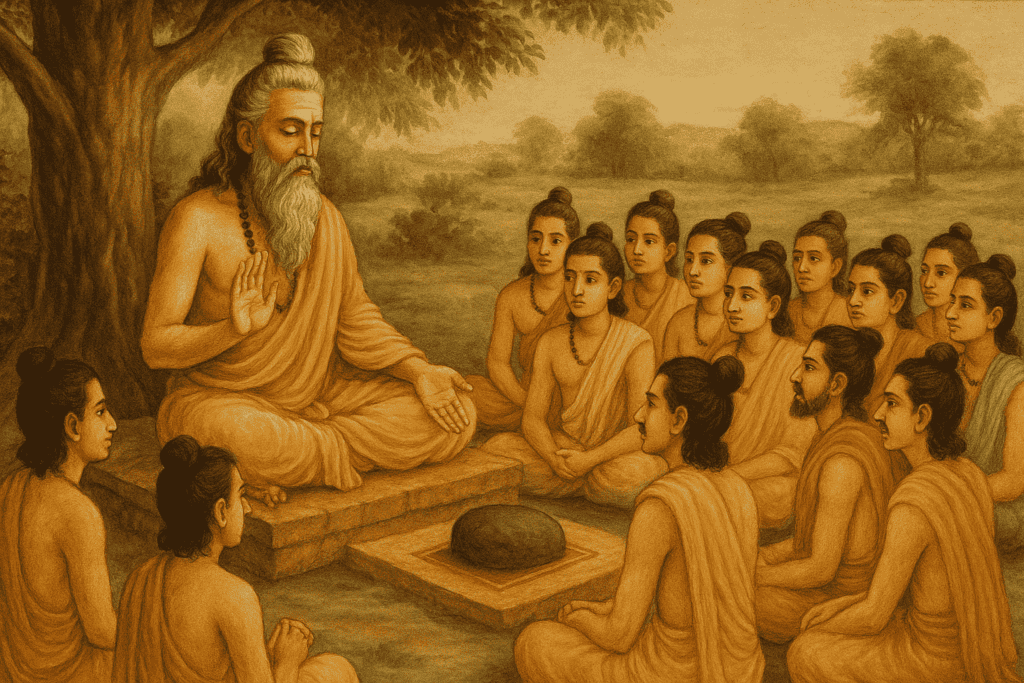

The Transformative Power of Karma Yoga
A Fall from Wisdom to Darkness
In the ancient lineage of the sage Kausika lived a learned Brahmin named Jada. He was born into wisdom, grace, and prosperity — blessed with knowledge of the scriptures and a comfortable life. Yet, as often happens in the human story, knowledge without discipline led him astray. Over time, Jada succumbed to the temptations of the world — gambling, greed, and reckless indulgence. His learning became mere ornamentation, his life a cautionary tale of how wisdom, when untethered from dharma, can be lost to the currents of desire.
He squandered his wealth in gambling dens and deceitful games until fortune abandoned him. Reduced to poverty and humiliation, he turned to theft to sustain himself — a tragic descent from sacred study to sin. But as the saying goes, “Adharma always devours its own.” One fateful night, envious villagers, jealous of his ill-gotten wealth, murdered him in his sleep and stole everything he had.
Thus ended Jada’s earthly journey — not in glory or grace, but in violence and greed. Yet death was not his release.
The Ghost Bound by Ignorance
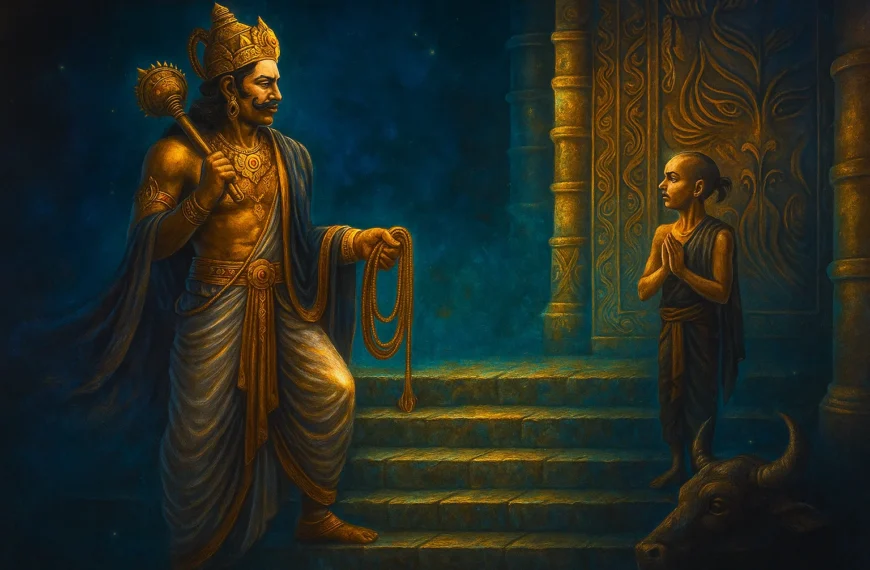
Deprived of his mortal body, Jada’s spirit wandered as a restless ghost, bound to the earth by his karmic burden. He was tormented by thirst and confusion, shrouded in ignorance so thick that even his senses — of sight, smell, and touch — had faded into darkness. The wealth he had once sought with such obsession now meant nothing. He was a soul bereft of peace, condemned to wander in the unseen realms, a victim of his own misdeeds.
His suffering was not unique — it was the fate of countless beings trapped in the cycle of ignorance, ego, and attachment. Yet, as every Hindu scripture reminds us, divine grace often finds a way to reach even the most fallen of souls.
The Son’s Return and the Power of Divine Sound
Jada had a son named Mohan, a noble-hearted man who had left his homeland years earlier in pursuit of honest trade. Upon his return, he learned of his father’s death and dutifully performed all śrāddha rites — the sacred ceremonies meant to bring peace to departed souls. But unknown to him, his father’s spirit remained in bondage, unable to ascend to higher realms.
One day, a friend of Mohan — a learned devotee — visited his home. After his morning ablutions and prayers, the friend sat down to recite the third chapter of the Bhagavad Gita — Karma Yoga, the Yoga of Action.
As the verses flowed through the air, sanctified by intention and devotion, a miracle unfolded. The sound of those divine words pierced through the veil of ignorance surrounding Jada’s spirit. Bound by sin and delusion for lifetimes, he suddenly found clarity. The shackles that held him to the earthly plane dissolved. His ghostly form shimmered with light, and before the astonished eyes of his son, Jada was transformed — radiant, serene, and freed.
A celestial chariot descended from the heavens, accompanied by divine maidens bearing garlands and music. Jada, now sanctified by the power of Gita’s third chapter, turned to his son with profound gratitude.
The Father’s Blessing
“My beloved son,” he said, “I have been delivered from the bondage of flesh and ignorance merely by hearing the recitation of the third chapter of the Gita. Yet your ancestors — your brothers and forefathers — still suffer in the realms of darkness. Take up the regular recitation of this chapter, and through your devotion, release them too from their pain. The Gita’s word is not mere poetry — it is the vibration of divine order itself.”
Blessing his son, Jada ascended into the celestial chariot and departed for the higher realms, leaving behind the fragrance of liberation.
The Continuation of Faith
Mohan, deeply moved by this revelation, began to recite the third chapter daily. His practice was not mechanical — it was born of devotion, gratitude, and understanding. With each verse, he invoked the eternal principle of selfless action, as taught by Lord Krishna to Arjuna.
When Mohan and his friend eventually left their mortal bodies, both ascended to the same celestial realms where his father had gone — united in light, beyond the reach of karma.
The Eternal Wisdom of the Third Chapter – Karma Yoga
The third chapter of the Bhagavad Gita, known as Karma Yoga, is not a call to renounce the world but to purify one’s relationship with action. It teaches us how to act in alignment with dharma, without attachment to the fruits of our labor.
In this chapter, Arjuna — bewildered by doubt — asks Krishna:
“If knowledge is superior to action, O Krishna, then why do you urge me to engage in this dreadful battle?”
Krishna’s divine response reveals the heart of human spirituality — the harmony of knowledge and action. He explains that life in this world cannot be devoid of action; even the simple act of breathing is participation in the great web of karma. But the wise act without attachment, dedicating every deed to the Divine, thereby transforming action into worship.
Krishna says:
“Perform your duty with detachment, for action performed in selfless spirit purifies the heart. Even Janaka and other wise kings attained perfection through rightful action.”
True Karma Yoga lies in this balance — to engage fully in the world, yet remain inwardly free. One who acts without ego or craving is untouched by sin, like a lotus leaf that remains untainted by the water it floats upon.
The chapter also warns of the enemies of the soul — desire and anger, born from attachment. Krishna urges Arjuna to master the senses, control the restless mind, and rise above the ego. For the self, higher than the intellect, must govern the body and mind, not the other way around.
The Message for the Modern Seeker
The story of Jada is not merely a myth from an ancient past — it is a parable for every human being living today. Many of us, like Jada, begin with good intentions but get lost in the maze of worldly pursuits. Our restlessness, our endless thirst for “more,” often leads to an inner death long before the physical one.
Yet the message of the Bhagavad Gita’s Karma Yoga remains timeless — redemption is always possible. Even one sincere moment of contact with divine truth, one pure act of devotion, one verse heard with faith can reverse lifetimes of ignorance.
In an age where people chase results and forget meaning, Krishna’s words remind us:
“Your right is to action alone, not to its fruits. Let not the fruits of action be your motive, nor let your attachment be to inaction.”
Through selfless service, purity of intention, and devotion to the Divine, the restless human soul finds peace — just as Jada found liberation through the sound of sacred wisdom.
Conclusion
The third chapter of the Bhagavad Gita is not merely a guide to duty — it is a manual for inner freedom. It teaches that salvation is not in escape but in participation — in doing one’s dharma with mindfulness, humility, and surrender.
Just as Jada’s spirit was lifted from suffering through the transformative power of sacred sound and selfless intent, we too can awaken from the darkness of ignorance by aligning our actions with truth.
The Gita whispers across the ages —
that bliss is not in renunciation of life,
but in the renunciation of selfishness within life.

 By
By